
How High Is USB-to-CAN Latency? Multi-Device Linux RT Benchmark and 1–2 kHz Real-Time Control Verification
USB-to-CAN adapters are often assumed too slow for 1 kHz closed-loop control. While true on some conventional analyzers (640.1 µs one-way P99), real-time Linux tests show nearly a 9× gap across architectures:
1. Call Boundaries and Tail Bounds: SocketCAN vs. write(can0)
As Figure 1 shows, certain traditional analyzers exceed 1.28 ms in a single round-trip, whereas hardware built around the KCAN real-time forwarding protocol engine keeps one-way mean at 42.2 µs and P99 within 65.0 µs. In terms of everyday Linux code boundaries, "one-way latency" measures the following intervals (after subtracting fixed physical bit-stream wire time on the CAN twisted pair):
- Kernel one-way latency (default view in Figure 1): Elapsed time from the SocketCAN kernel driver dispatching a frame, across USB and adapter hardware, until the CAN transceiver begins driving the physical start-of-frame (SOF) bit onto the bus (and symmetrically from bus EOF back to the kernel network stack). On native
KHCM104, this measures 42.2 µs mean (65.0 µs P99). - What about user-space
write(can0)? Counting directly from user code callingwrite(can0)(and inbound throughrecvmsg()return) onPREEMPT_RTLinux adds only ~6.3 µs of unilateral syscall and wakeup overhead—meaning fromwrite(can0)to physical CAN bus transmission start averages ~48.5 µs (P99: 72.6 µs, P99.9: 85.4 µs), compared with 158.4–404.4 µs mean (234.9–662.0 µs P99) on conventional analyzers.
In fixed-period control, loop stability is governed by P99 / P99.9 tail bounds rather than averages:
- Kunhong architecture (
KHCM104/KH-UCANFD): 99% of frames complete within 65.0 µs (99.9% within 78.1 µs), consuming under 15% of a 1 kHz cycle across a round-trip. - Conventional bus analyzers: One-way P99 reaches 216.6–640.1 µs, where a single round-trip approaches or exceeds an entire 1 ms control period.
2. Why Such a Wide Gap? USB Is Fast—Internal Forwarding Differs
Every tested device plugged into the same host USB port, proving the multi-hundred-microsecond gap lies not on the USB cable, but inside device-side protocol forwarding (Figure 2):
- Physical USB 2.0 wire transfer takes ~1.3 µs: Over 480 Mbit/s High-Speed USB, transmitting a single CAN FD packet occupies minimal wire time.
- Conventional analyzers traverse deeper software stages: Built primarily for bus monitoring and logging, conventional adapters pass frames through multi-stage internal software buffering and protocol conversion, incurring hundreds of microseconds of internal residence delay.
- KCAN real-time forwarding protocol engine: The KHCM104 controller IC integrates a High-Speed USB 2.0 PHY on-chip alongside the KCAN real-time forwarding protocol engine, compressing internal transit overhead to microseconds across all KCAN-enabled products.
3. Zero Host Driver Changes: How Much Does Hardware Alone Save?
To verify whether low latency depends on a custom driver or on the hardware itself, we used the multi-firmware capability of the KH-UCANFD-X2I (CANmeleon firmware) for a three-step controlled comparison (Figure 3):
This gives engineering teams two practical deployment options:
- Existing stacks with zero host code changes: Keeping Ubuntu's stock
peak_usborkvaser_usbdriver unchanged and swapping hardware toKH-UCANFD-X2Icuts kernel one-way mean from 369.4 µs directly to 48.3 µs—eliminating over 85% of forwarding delay. - New designs targeting tightest jitter: Pairing with the native
kcandriver in the KH-UCANFD Linux SDK brings mean latency down to 42.1 µs and tightens P99 to 64.8 µs.
4. In a 1–2 kHz Joint Control Loop, How Much Compute Time Remains?
Substituting measured application-layer timings for KH-UCANFD-B2B-X4 (including write / recvmsg syscalls: 48.5 µs mean, 85.4 µs P99.9) into a daisy-chained actuator bus (1/8 Mbit/s) yields the system topology and 1 ms cycle breakdown in Figure 4:
Quick-reference single-cycle closed-loop durations across node counts and bit rates are listed below (subtract the P99.9 Bound from your target cycle period to evaluate margin alongside host compute time and clock-sync needs; custom payload lengths can be checked with the Online CAN/FD Frame Length Calculator):
| Single-Channel Scale (ISO CAN FD) | Per-Cycle Frame Mix | Typical Loop Time | P99.9 Bound |
|---|---|---|---|
| 1-Node Minimal Loop (1/8 Mbit/s) | 1×8 B cmd + 1×8 B feedback | 201 µs | 289 µs |
| 2-Node High-Rate Loop (1/8 Mbit/s) | 1×16 B aggregated cmd + 2×8 B feedback | 255 µs | 345 µs |
| 4-Node Limb Loop (1/8 Mbit/s) | 1×32 B aggregated cmd + 4×16 B feedback | 396 µs | 499 µs |
| 4-Node Long-Harness Loop (1/5 Mbit/s) | 1×32 B aggregated cmd + 4×16 B feedback | 472 µs | 582 µs |
- 1 kHz with 4 joints per channel: Even at the 99.9th percentile (P99.9), communication plus actuator sampling takes 499 µs—leaving over 500 µs for whole-body dynamics or policy inference, while a single 4-channel
KHCM104drives 16–24 joints concurrently. - 2 kHz with 2 joints per channel: Total loop time stays within 345 µs at P99.9, leaving ~155 µs of compute margin.
Tested Hardware Links and Full Benchmark Report
Click thumbnails to enlarge, or click model names for Kunhong specifications and official third-party vendor product pages:
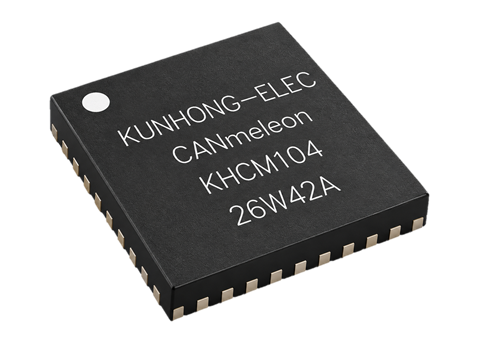
On-chip HS USB 2.0 PHY & KCAN real-time forwarding engine for custom carrier boards.
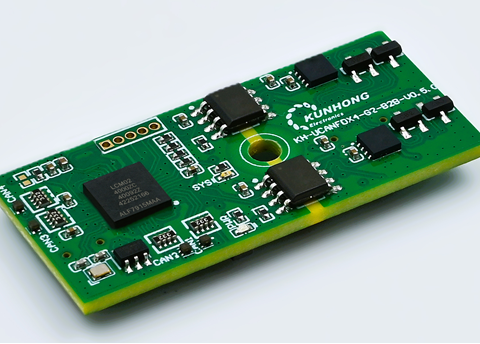
Compact 2 / 4-ch board-to-board module driving 16–24 robot joints over one USB 2.0.
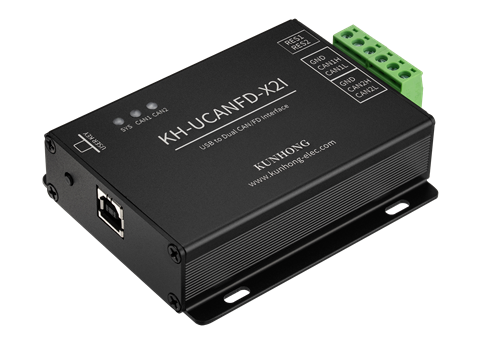
Galvanically isolated dual-channel adapter supporting KCAN & CANmeleon firmware.
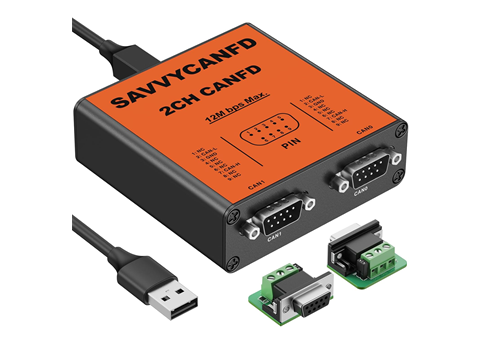
Pibiger dual-channel USB-CAN FD adapter (FW 3.2.0, in-tree peak_usb comparison).
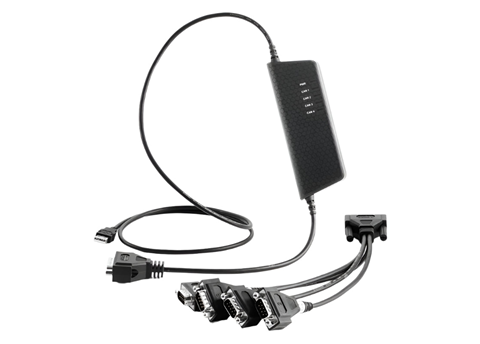
Kvaser 4-channel CAN FD interface (FW 3.25.855, in-tree kvaser_usb baseline).
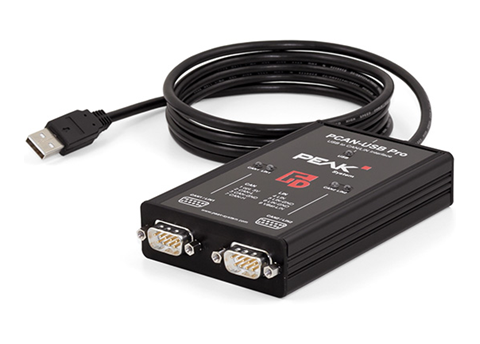
PEAK-System dual-channel CAN FD / LIN interface (IPEH-004061, FW 3.5.4, peak_usb).
NOTE
Full Test Methodology and Raw Datasets: All figures cited here come from a controlled benchmark totaling 3.8 million frames with zero drops (9 device setups × 300k frames + 11 bit-rate/period sweeps × 100k frames). For T1–T4 timestamp capture principles, per-frame bit-stuffing deduction equations, full 9-setup quantile tables, Linux low-jitter tuning settings, and downloadable CSV/JSON raw files, see the companion report: USB-CAN FD Real-Time Latency Benchmark Report: Methodology, Multi-Device Statistical Analysis, and Raw Datasets.