KHCM100 Series
Product overview
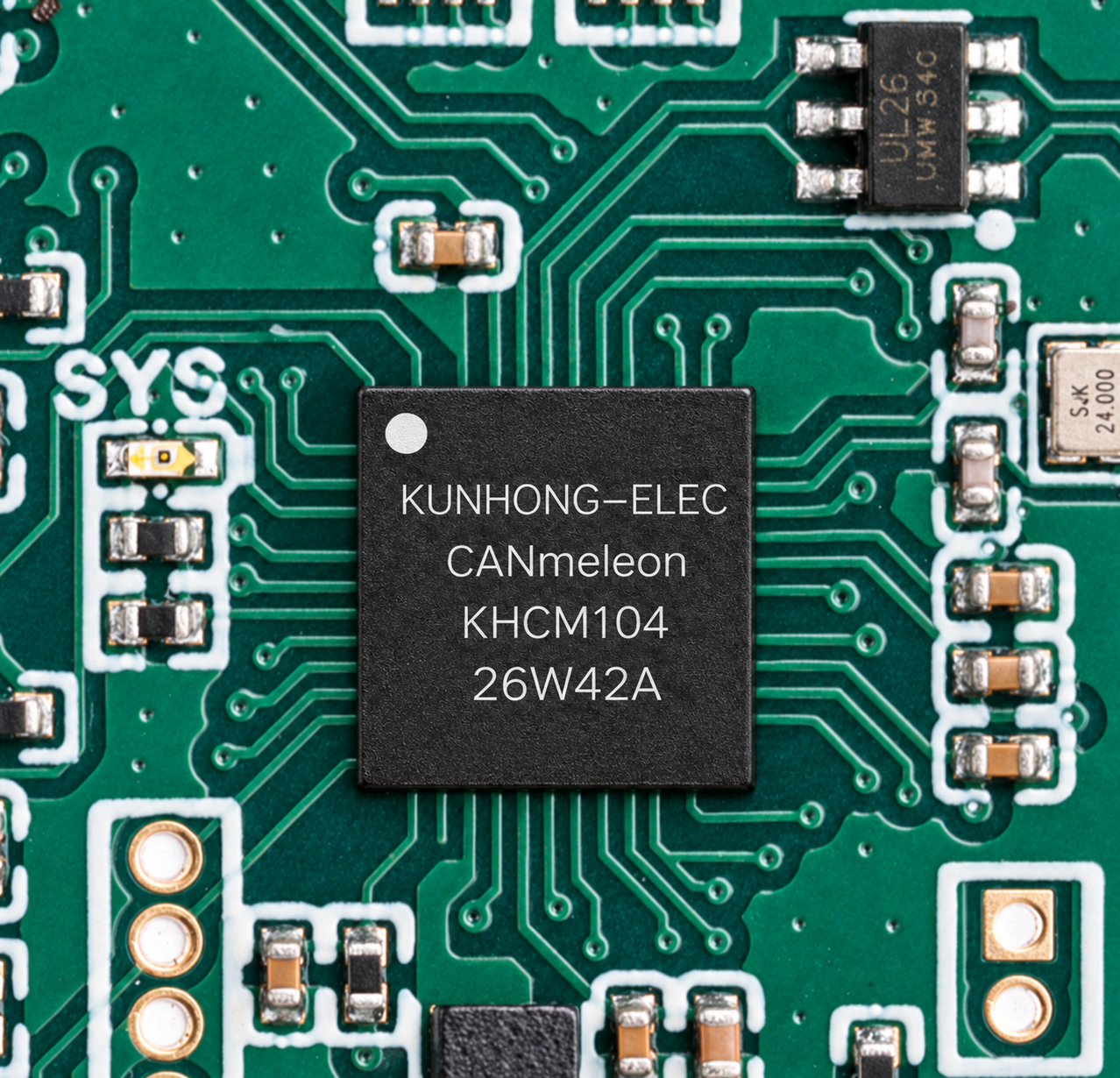
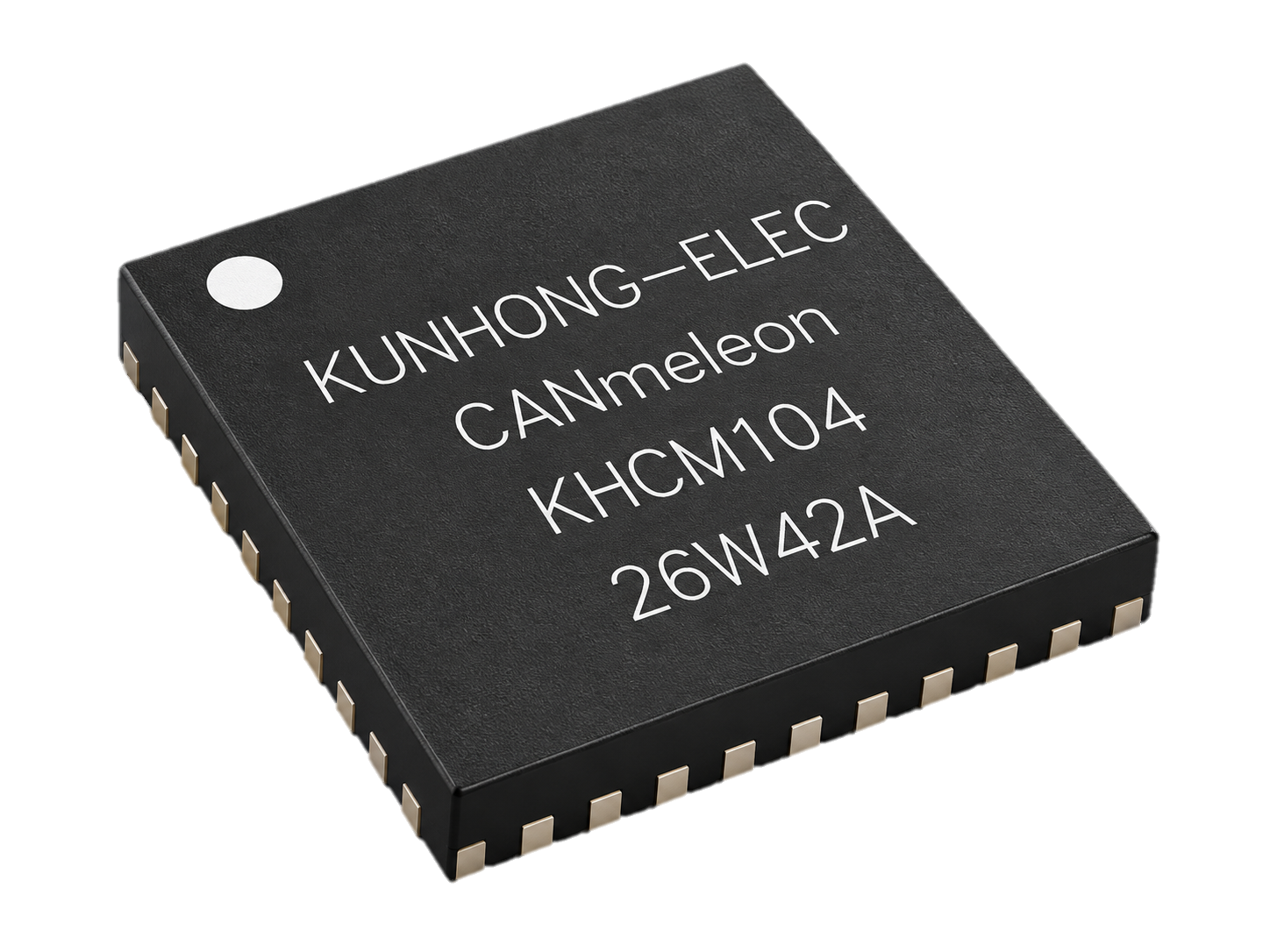
The KHCM100 series connects a USB host to multiple CAN/CAN FD channels. Each chip integrates a high-speed USB device controller and PHY, two or four independent CAN/CAN FD controllers and an updatable USB-CAN protocol engine in a 6 × 6 mm QFN48 package with an exposed pad.
Model selection
| Model | Independent CAN/CAN FD channels | Package | Operating ambient temperature | Status |
|---|---|---|---|---|
| KHCM102 | 2 | QFN48 with exposed pad, 6 × 6 mm | −40 to 105 °C | In production |
| KHCM104 | 4 | QFN48 with exposed pad, 6 × 6 mm | −40 to 105 °C | In production |
Both models require external CAN/CAN FD transceivers. Connect each channel’s TX/RX signals to the logic side of a transceiver, and connect the transceiver to CAN_H and CAN_L. Select the transceiver and protection components for the system’s logic levels, target bit rate and isolation requirements.
Key features
| Feature | Specification or function |
|---|---|
| Host interface | USB 2.0 High Speed, 480 Mbit/s, integrated USB PHY |
| CAN bit rates | Classical CAN up to 1 Mbps; CAN FD data phase up to 12 Mbps |
| CAN transceivers | External transceivers required |
| Concurrent communication | The KHCM104 supports simultaneous full-load operation on four CAN FD channels at 29,000 frames/s per channel |
| Forwarding latency | 18 µs minimum, 40 µs typical |
| Timestamping and synchronization | 1 µs hardware CAN timestamps and time synchronization across multiple USB devices |
| Bus monitoring | Bus load measurement, error frame detection and bus status monitoring |
| Channel controls | Tri-color status LEDs and software-controlled CAN termination |
Core advantages
- Multiple channels on one chip. One KHCM104 manages four independent CAN/CAN FD channels through a single high-speed USB device interface, suitable for compact adapters and interface cards.
- Firmware-selectable host protocol. Device designers can install or switch existing CANmeleon firmware to work with the required host software without writing and maintaining USB protocol firmware.
- Per-channel status and termination control. A device can provide a tri-color status LED for each channel and use software to control the board’s CAN termination resistors.
USB protocol and firmware
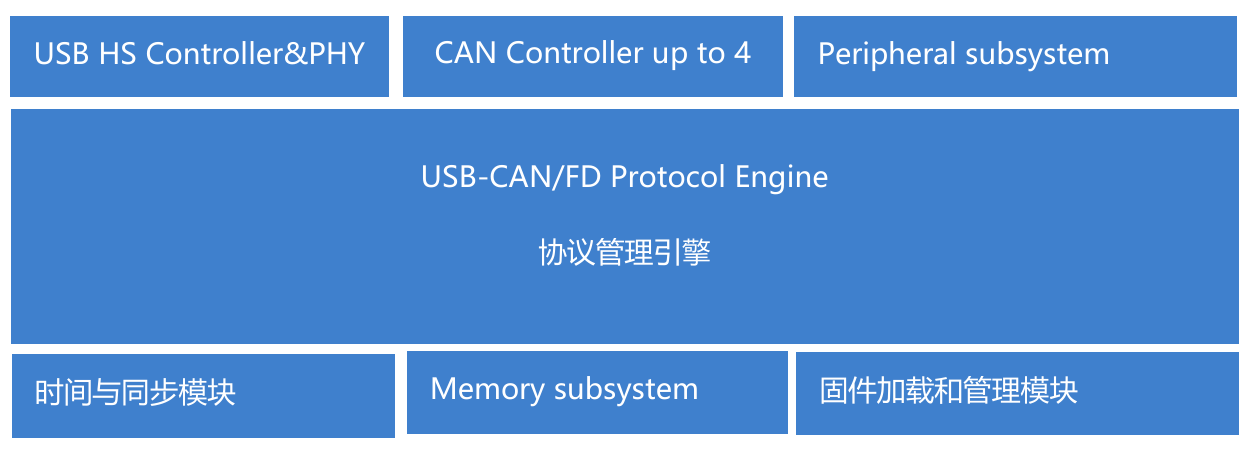
The chip supports online and offline firmware installation and updates. Switching firmware changes the USB protocol presented to the host.
Host platforms include Windows, Linux and macOS on x86 and ARM systems. Linux applications can use SocketCAN or a shared library (.so). Check the operating systems and drivers supported by the selected firmware before choosing host software. See the CANmeleon firmware catalog and the device manager guide.
Multi-Firmware Support
- KHCM102 — KCAN X4, GS USB, PCAN FD / Pro, PCAN-USB, Kvaser FD, Kvaser Leaf, Vector VN16xx, ZLG USBCANFD, ZLG USBCAN-II, ZLG USBCAN-2E-U, CANalyst-II, ETAS ES582
- KHCM104 — KCAN X4, GS USB, PCAN FD / Pro, Kvaser FD, ZLG USBCANFD
Use CANmeleon Device Manager to check the firmware available for your model and license. See each firmware page for supported modes, channel counts and driver requirements.
Hardware integration and design resources
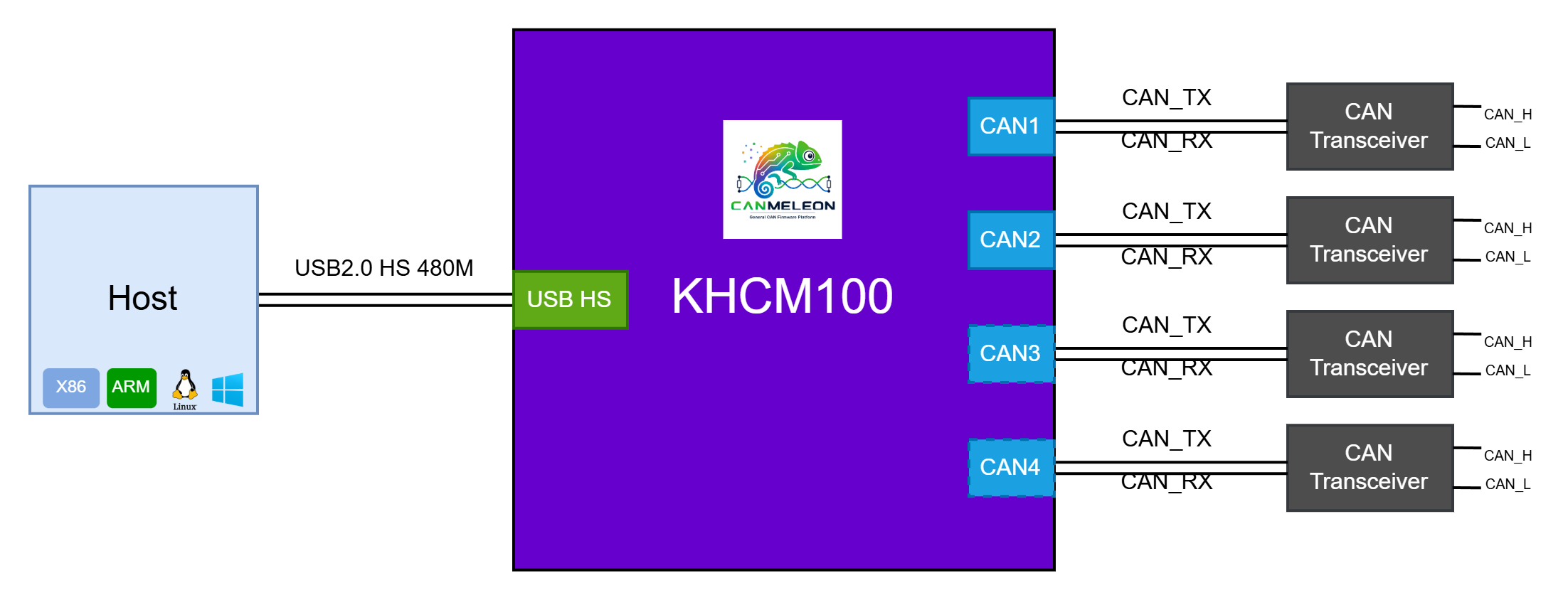
For more channels, use a USB hub to connect multiple KHCM100 series chips to one host. Refer to the KHCM100 series USB-CAN FD ASIC datasheet (DS-KHCM100-ZH) for pin assignments, power connections and electrical specifications.
Design resources include the KHCM100 EVB evaluation board, hardware reference designs and a hardware design guide. For OEM production firmware configuration tools, custom firmware development, schematic review and hardware or software integration support, contact Kunhong.
Typical applications
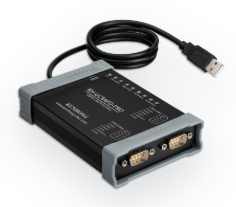
- USB-CAN FD adapters and analyzers. Connect a computer to a CAN/CAN FD bus over USB to capture hardware-timestamped frames and monitor bus load and error frames.
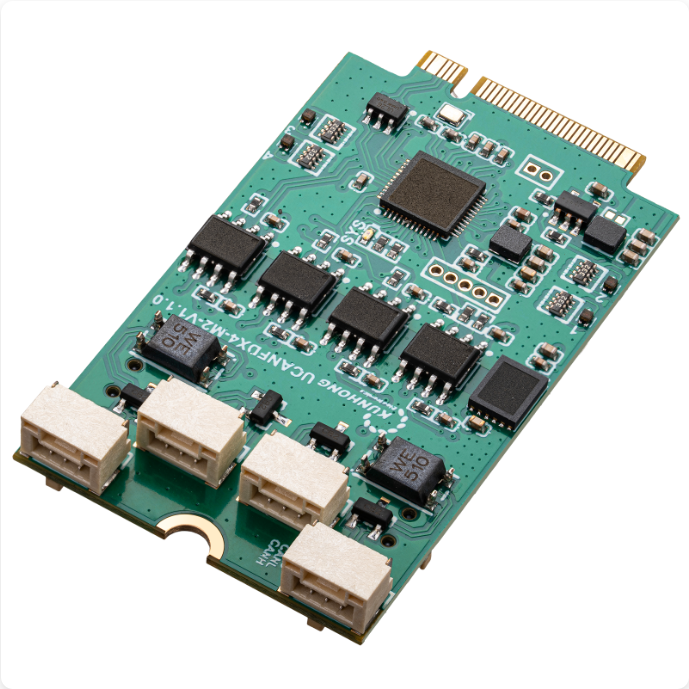
- CAN/FD interface cards for industrial PCs. Integrate the chip on an expansion card to provide two or four CAN/CAN FD channels through the PC’s USB interface.
- CAN/FD expansion for robot controllers. Add independent CAN/CAN FD channels to a robot controller to connect bus nodes and monitor communication on each channel.